The Problem
Students who study well still fail exams. They know the content but collapse under exam conditions: 3 hours, silent hall, paper they've never seen, clock running. Knowledge is necessary but not sufficient. Exam performance is a separate skill — and mock tests are how you build it.
Students who study well still fail exams. They know the content but collapse under exam conditions: 3 hours, silent hall, paper they've never seen, clock running. Knowledge is necessary but not sufficient. Exam performance is a separate skill — and mock tests are how you build it.
Why Mock Tests Are Non-Negotiable
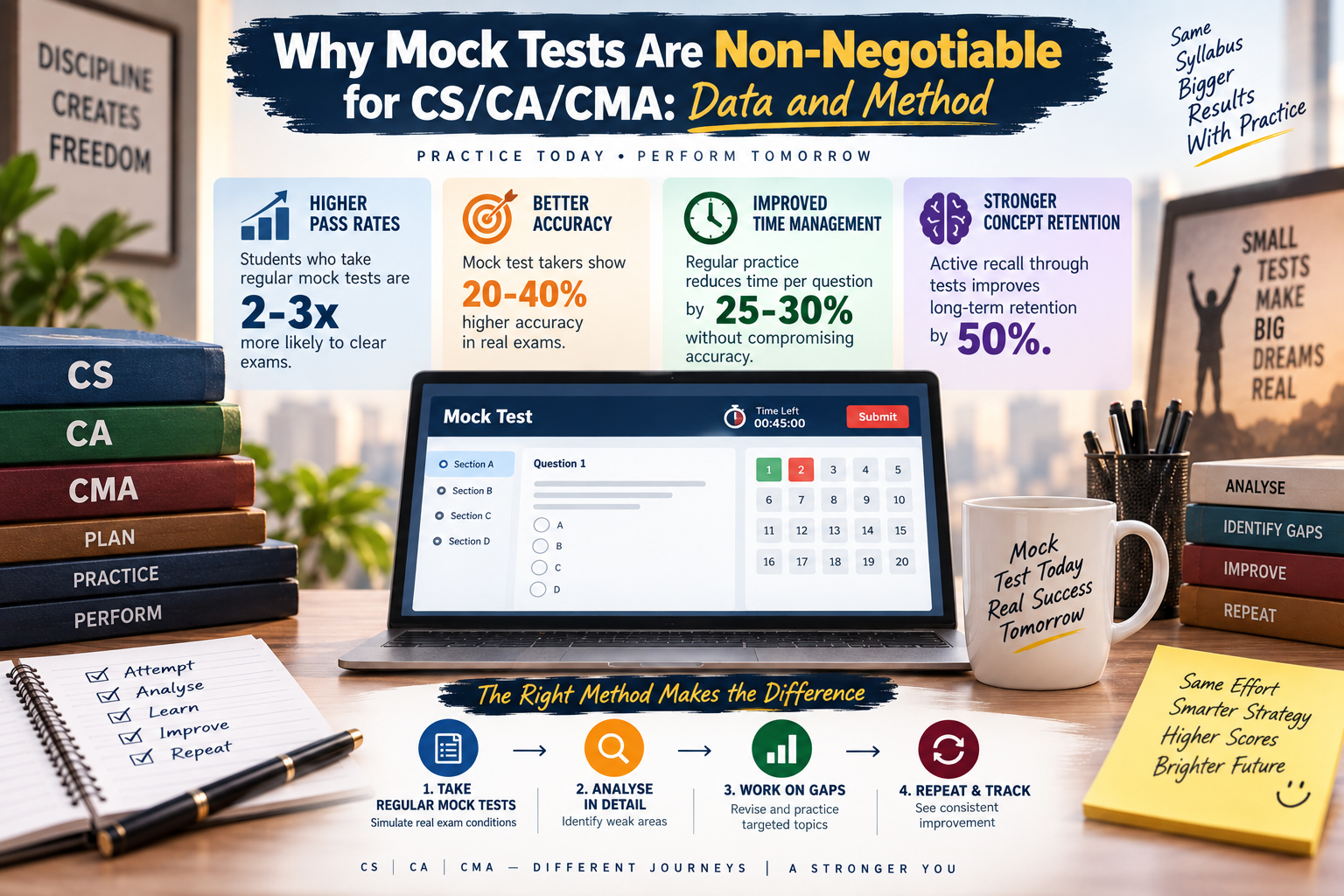
A mock test is not a test of what you know. It's a simulation of the actual exam — building the specific skills of time management, pressure handling, question selection, and answer structure that the exam demands. You cannot develop these skills by studying. Only practice under exam conditions builds them.
🔬 The Testing Effect (Again, But Critically)
Multiple studies confirm that students who practice under test conditions outperform those who study the same material without testing — even when total study time is equal. Mock tests also identify gaps that passive study misses: you don't know what you don't know until a question exposes it.
Multiple studies confirm that students who practice under test conditions outperform those who study the same material without testing — even when total study time is equal. Mock tests also identify gaps that passive study misses: you don't know what you don't know until a question exposes it.
The 3 Purposes of Mock Tests
Purpose 1: Diagnostic
Early mocks (2–3 months before exam) reveal which topics are weak before you run out of time. A mock at this stage is a gift — it tells you exactly where to focus.
Early mocks (2–3 months before exam) reveal which topics are weak before you run out of time. A mock at this stage is a gift — it tells you exactly where to focus.
Purpose 2: Skill Building
Mid-preparation mocks build exam skills: time allocation, question sequencing, partial-answer strategy. Do 3 mocks per subject at this stage under full exam conditions.
Mid-preparation mocks build exam skills: time allocation, question sequencing, partial-answer strategy. Do 3 mocks per subject at this stage under full exam conditions.
Purpose 3: Confidence and Calibration
Final-month mocks build familiarity with exam format and pressure. Repeated exposure reduces anxiety. After 5 mocks per paper, the exam feels familiar — not terrifying.
Final-month mocks build familiarity with exam format and pressure. Repeated exposure reduces anxiety. After 5 mocks per paper, the exam feels familiar — not terrifying.
The Mock Test Protocol
📅 Schedule mock test date in advance (2+ weeks out)
↓
⏰ Sit at exact exam time (9am for morning paper)
↓
📝 Full exam conditions: no notes, no phone, timed
↓
✍️ Complete the paper within time limit
↓
🔍 Mark your own paper against model answers
↓
📊 Categorise errors: knowledge gaps vs. exam technique
↓
🎯 Address each category specifically before next mock
Mock Test Strategy for Each Stage
💡 Mock Test Schedule (6-Month Preparation)
Month 1–3 (Learning phase): Topic-wise tests after completing each chapter. Not full papers yet.
Month 4 (First full mocks): 1 full paper per subject. Diagnostic purpose. Don't panic at the score — use it.
Month 5 (Skill-building): 2 full papers per subject. Focus on time management and answer structure.
Month 6 (Final month): 2–3 papers per subject under timed conditions. Focus on confidence and consistency.
Month 1–3 (Learning phase): Topic-wise tests after completing each chapter. Not full papers yet.
Month 4 (First full mocks): 1 full paper per subject. Diagnostic purpose. Don't panic at the score — use it.
Month 5 (Skill-building): 2 full papers per subject. Focus on time management and answer structure.
Month 6 (Final month): 2–3 papers per subject under timed conditions. Focus on confidence and consistency.
⚠️ Most Common Mock Test Mistakes
❌ Waiting until "ready" to take mocks (you're never ready — start anyway)
❌ Open-book mocks (defeats diagnostic purpose entirely)
❌ Not timing yourself (exam pace is a separate skill)
❌ Not reviewing errors systematically — just moving on
❌ Only doing 1 mock per subject total
❌ Waiting until "ready" to take mocks (you're never ready — start anyway)
❌ Open-book mocks (defeats diagnostic purpose entirely)
❌ Not timing yourself (exam pace is a separate skill)
❌ Not reviewing errors systematically — just moving on
❌ Only doing 1 mock per subject total
❌ No Mock Tests
- First encounter with exam pressure = actual exam
- Time runs out before completing paper
- Topic gaps discovered in exam hall
- Anxiety makes familiar content inaccessible
✅ Systematic Mock Tests
- Exam conditions become familiar and manageable
- Time allocation automatic from practice
- Gaps identified and fixed pre-exam
- Confidence from repeated successful attempts
🎯 Take a Mock This Weekend
Pick your weakest subject. Download a past paper. Saturday morning, 9am — close everything, set a 3-hour timer, attempt the paper. Don't cheat. Then review. That single mock will tell you more than a week of passive study.
Pick your weakest subject. Download a past paper. Saturday morning, 9am — close everything, set a 3-hour timer, attempt the paper. Don't cheat. Then review. That single mock will tell you more than a week of passive study.
- Mock test dates scheduled in study planner
- First mock taken for each subject (diagnostic)
- Mock conditions match real exam (timed, no notes)
- Each mock reviewed and errors categorised
- Minimum 5 full mocks per subject before exam
- Final mock within 2 weeks of actual exam date
🔑 Key Takeaway
A pilot doesn't learn to fly from textbooks alone. Flight simulators build real-world performance under pressure. Mock tests are your flight simulator. The exam is not the time to discover your weaknesses — mock tests are. Take them. Take them seriously. Take them often.
A pilot doesn't learn to fly from textbooks alone. Flight simulators build real-world performance under pressure. Mock tests are your flight simulator. The exam is not the time to discover your weaknesses — mock tests are. Take them. Take them seriously. Take them often.
Mind Mapping vs. Linear Notes: Retention Research
Study Method Preference vs. Exam Score Correlation
CA Inter students by preferred note method (n=280)
| Note Method | Avg Score (Theory) | Avg Score (Application) | Time per Chapter |
|---|---|---|---|
| No notes (reading only) | 38% | 31% | 1.5 hrs |
| Linear notes (copying) | 52% | 44% | 2.5 hrs |
| Mind maps (concept-first) | 67% | 61% | 2 hrs |
| Mind maps + active recall | 79% | 72% | 2.5 hrs |
Sample Mind Map: Ind AS 36 (Impairment)
Central Node: Ind AS 36 — Impairment of Assets
Branch 1: WHEN TO TEST
→ Indicators of impairment (external + internal)
→ Annual mandatory: Goodwill, intangibles with indefinite life
Branch 2: HOW TO MEASURE
→ Recoverable Amount = Higher of:
→ Fair Value less costs of disposal
→ Value in Use (PV of future cash flows)
Branch 3: RECOGNITION
→ CA > RA = Impairment Loss
→ P&L for individual assets
→ OCI first for revalued assets
Branch 4: CGU (Cash Generating Unit)
→ Smallest identifiable group generating independent inflows
→ Goodwill allocated to CGUs
Branch 5: REVERSAL
→ Allowed (not for Goodwill)
→ Cannot exceed original carrying amount pre-impairment
Branch 1: WHEN TO TEST
→ Indicators of impairment (external + internal)
→ Annual mandatory: Goodwill, intangibles with indefinite life
Branch 2: HOW TO MEASURE
→ Recoverable Amount = Higher of:
→ Fair Value less costs of disposal
→ Value in Use (PV of future cash flows)
Branch 3: RECOGNITION
→ CA > RA = Impairment Loss
→ P&L for individual assets
→ OCI first for revalued assets
Branch 4: CGU (Cash Generating Unit)
→ Smallest identifiable group generating independent inflows
→ Goodwill allocated to CGUs
Branch 5: REVERSAL
→ Allowed (not for Goodwill)
→ Cannot exceed original carrying amount pre-impairment
This mind map takes 15 minutes to draw from memory after reading the standard. The act of reconstruction IS the learning. You can verify completeness against your text after drawing. Each branch becomes a flashcard trigger — "what are the branches of Ind AS 36?" can be answered in full from a single recall of the map.
🎓 E-mentor + Mind Maps: Test Your Map
After creating a mind map for any chapter, immediately take the E-mentor chapter test for that topic. Questions you can't answer point to branches of your mind map that are incomplete or wrong. Go back, fix those branches specifically, and re-test in 3 days. This cycle — map, test, fix, re-test — is the most efficient route to thorough chapter mastery. The visual memory of your corrected map will recall the correction in the exam hall.
After creating a mind map for any chapter, immediately take the E-mentor chapter test for that topic. Questions you can't answer point to branches of your mind map that are incomplete or wrong. Go back, fix those branches specifically, and re-test in 3 days. This cycle — map, test, fix, re-test — is the most efficient route to thorough chapter mastery. The visual memory of your corrected map will recall the correction in the exam hall.
📎 Official Resources